You might be reading this post in an unprecedented state of lockdown or at least of social isolation. But contagious diseases have been around as long as people have. Measles and, to a lesser extent, diphtheria, scarlet fever, typhoid fever, and chicken pox are an important backdrop in Elsie J. Oxenham’s world and appear frequently. These highly infectious diseases are a Very Useful Plot Device for a novelist! They are more useful than, say, a heavy snowfall or a flood as these latter situations can usually be resolved relatively quickly: roads are opened and floodwaters recede. Instead, contagious diseases can uproot or close a school for a lengthy period of time; they can separate characters or cause them to have to go into quarantine and miss school. A character’s reaction to a disease can also tell us something about her. Elsie J. Oxenham’s approach to contagion and quarantine seems quaint and almost benign in our world of the Covid-19 pandemic. [Read more…]
Elsie J. Oxenham, the Abbey Girls and A10_Tomboys at the Abbey

Appearing in 1957 and the third-to-the-last book to be published prior to Elsie J. Oxenham’s death, A10_Tomboys at the Abbey is, mercifully, the last of the Retrospective Titles. With one important exception, it is a weak installment: repetitive and unconvincing. There is nothing in it for folk dancers, so if that is your principal interest in this blog, you can stop reading right now!
The exception, however, is an extremely interesting one that is not addressed in any of EJO’s other works, as far as I know; in Tomboys, characters successfully advocate for a girl to be able to pursue her career even after marriage. [Read more…]
A09_Selma at the Abbey

Published in 1952, A09_Selma at the Abbey takes place from September 1918 through May 1919 in Abbey Time. It starts two months after the activities of Strangers at the Abbey, and is a much better story, with a nice romance and a happy ending. It is also one that first introduces to the Abbey world a Swedish sea captain. Elsie J. Oxenham had a weird fascination with both Sweden and with sea captains—Stella Waring and Sheila Ray note that she had an elevated and inaccurate view of the social standing of the latter! Selma’s father was a Swedish sea captain—a double benefit! In a future post [Read more…]
A08_Strangers at the Abbey
 This installment runs from May through August 1918, “Abbey Time” (which is calculated based on the characters’ ages and which May Queen is ruling), but it contains physical elements, such as transatlantic commercial air travel and ballet, more suitable to 1951, which is when the book was published. I didn’t notice this uneasy interpolation when I read Strangers at the Abbey out of order, but when we return to the installments published in the 1920s, we will return to a world where motor cars were open, where phones in houses were known but rare, and where women automatically gave up their jobs upon marriage. Strangers is also an installment in which the Abbey Girls and their seventy-one-year old creator wax eloquent [Read more…]
A07_Schoolgirl Jen at the Abbey

Published by Collins in 1950, the same year as A34_Guardians of the Abbey, this is the fourth of the Retrospective titles and carries on with the exploits of young Jen Robins, one of the most popular of the Abbey Girl characters. In “Abbey Time,” the story takes place in July through September of 1917, beginning a few weeks after A06_Stowaways in the Abbey, ends. The latter installment was published in 1940; it is amazing [Read more…]
A06_Stowaways in the Abbey
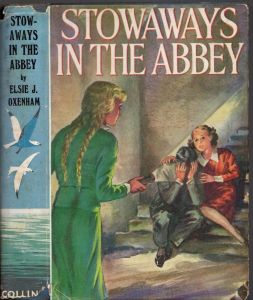
Published in 1940, A06_Stowaways in the Abbey is set in June and July of 1917, about three weeks after the prior installment. Like other titles in the Retrospective group, Stowaways reveals more about the story of lay-brother Ambrose and his Lady Jehane. This installment also shows us Jack’s good sense, Joan’s wiseness, Joy’s rather selfish impetuousness, and Jen’s innate [Read more…]
A05_Secrets of the Abbey

Published in 1939, A05_Secrets of the Abbey takes place in May and June of l917, Abbey time. Joan and Joy Shirley are eighteen—they apparently have left Miss Macey’s school, although this is not explicitly stated. The story has two main components—discovering what happened to lay-brother Ambrose and his love Lady Jehane after the dissolution of the Abbey, and Jen Robin’s hard but valiant choice [Read more…]
A04_Schooldays at the Abbey
 With A04_Schooldays at the Abbey, published by Collins in 1938, we begin the cluster of nine books known as the “Retrospective Titles.” They fall after A03_Girls of the Abbey School (1921) and the order resumes again in publication time with A11_The Abbey Girls Go Back to School (1922). The nine retrospective titles were published between 1938 and 1957, three years before Oxenham’s death. They feature younger girls [Read more…]
A03_The Girls of the Abbey School

A03_The Girls of the Abbey School introduces the important character of Janet (Jen) Robins, who will go on to become one of the strongest exemplars of the “Abbey spirit” of helpfulness and good will. Published in 1921, a year after Oxenham attended the 1920 Vacation School where presumably she discovered, as the Abbey Girls themselves will soon, how wrongly she had been dancing, the book contains a lot of dancing. It is dedicated “To those members of the English Folk Dance Society [Read more…]
A02_The Abbey Girls

After A01_Girls of the Hamlet Club, Elsie Oxenham published eight books, many dealing with the Camp Fire movement, before returning to Miss Macey’s school and establishing the true beginning of the story of the girls who live in the Abbey of Gracedieu. A02_The Abbey Girls was published in 1920 but is set two years after Cicely’s story, running from February through May 1916 in “Abbey Time.” There is no mention of the War.
[Read more…]
- « Previous Page
- 1
- …
- 3
- 4
- 5
- 6
- Next Page »